

How to Make a CEO Romance AI Short Drama (Billionaire Beat Sheet)

The billionaire CEO romance is the genre vertical drama was built on. In Chinese it has its own word, 霸总 (bà zǒng, the “domineering boss”), and the format barely changes from one hit to the next: a woman with nothing, a man with everything, a contract or an accident that forces them together, and a power gap that flips at the worst possible moment. Viewers know the shape and still pay to unlock episode 9. That is the point. The genre isn’t sold on surprise; it’s sold on delivery of a promised payoff at a reliable rhythm.
This guide is about that rhythm. You’ll get the four-beat episode skeleton, five sample episode beats you can adapt, the casting choices that make an AI version hold up, and how to produce it in DramaSo from idea to export. If you’ve never made any short drama, read how to make a short drama first; this page assumes you know what a vertical episode is.
Table of Contents
- Why the CEO romance works in 60 seconds
- The four-beat episode skeleton
- Five sample episodes: a season opening
- Casting the CEO and the heroine with AI
- How to make it in DramaSo, step by step
- Mistakes that kill a CEO romance
- FAQ
Why the CEO romance works in 60 seconds
Three things make this genre unusually good for one-minute episodes:
- The conflict is visible in one frame. A designer suit across a desk from a delivery uniform tells the whole power gap without a line of dialogue. Mute autoplay is fine.
- Every scene has a status move. Someone humiliates, someone protects, someone reveals. Each move is a small reversal, and reversals are what a 60-second episode needs every 15–20 seconds.
- The payoff is a promise, not a mystery. The audience knows she’ll win. What they pay for is the moment the people who looked down on her find out. You can deliver a small version of that moment every few episodes and save the big one for the finale.
Practical rule: In a CEO romance, the twist is rarely “who did it.” It’s “who knows.” Plan your season around who learns the secret, in what order.
To see the genre’s rhythm in a finished series, here is a full English-dubbed example of the “sold into marriage, he turns out to be the CEO” setup. Watch where each status reversal lands.
The four-beat episode skeleton
Every episode runs the same engine. Time it with a stopwatch, not by feel. This is a genre-specific version of the general 60-second hook formula.
| Beat | Time | Job | CEO romance version |
|---|---|---|---|
| Hook | 0–5s | An image that asks a question | She spills coffee on a stranger’s suit; the lobby goes silent. |
| Escalation | 5–35s | Pressure that can’t be paused | Her manager fires her on the spot; the stranger says nothing and watches. |
| Twist | 35–50s | A reversal of status or knowledge | The stranger walks into the board meeting and takes the chairman’s seat. |
| Cliffhanger | 50–60s | A new question, unanswered | He slides a contract across the table: “Marry me for one year.” Cut. |

Two notes. First, the twist reverses status, not plot. Something changes in who holds power in the room. Second, the cliffhanger is a new question, not the answer to the old one. “Who is he?” was answered at 0:45. “Why would he want her?” opens at 0:58.
Five sample episodes: a season opening
Here is a five-episode opening you can rewrite with your own names. Each line is one episode’s hook → escalation → twist → cliffhanger.
- Ep 1, The Spill. Coffee on a stranger → fired in public → stranger is the new chairman → he offers a one-year marriage contract.
- Ep 2, The Terms. She tears up the contract → her mother’s hospital bill arrives the same night → she signs → clause 7: “No falling in love.” He wrote it; his hand hesitates over it.
- Ep 3, The Family Dinner. His stepmother serves her the wrong fork on purpose → the table laughs → she answers in fluent French to the visiting investor → the stepmother’s phone lights up: a photo of her old delivery job.
- Ep 4, The Ex. Her ex-boyfriend turns up as his company’s new partner → he humiliates her at the signing → the CEO cancels the deal in front of everyone → the ex whispers: “Does he know what you did five years ago?”
- Ep 5, The Rain. She’s locked out in a storm after a fight → he finds her and gives her his coat → she sees a scar on his wrist she’s seen before → flashback: she pulled a boy from a river, years ago. Cut on his face.

Notice what episode 5 does: it plants the hidden-connection twist that the season can pay off around episode 30–40. The genre loves a buried childhood link because it turns “rich man saves poor girl” into “she saved him first.” That reversal is the payoff viewers unlock for.
Practical rule: Write the season’s last reveal first, then plant three visual clues to it in episodes 5, 15 and 25. Clues that are images (a scar, a pendant, a song) survive mute viewing; clues that are dialogue don’t.
Casting the CEO and the heroine with AI
The genre depends on faces staying the same. If the CEO’s jaw changes between episode 3 and episode 4, the romance reads as two different men. Before you write episode 1:
- Lock three looks per lead: work (suit / uniform), home (soft clothes), and the big-event outfit (gala, wedding). Wardrobe changes are where AI faces drift most.
- Give the CEO one visual tell that never changes: a watch, a ring, a scar. It anchors him across shots and doubles as a story clue.
- Cast the antagonists to contrast: the stepmother in cold colors, the ex in loud patterns. Viewers swipe fast; they should know who’s who in one frame.

One rule before you cast: build your leads from scratch, never from a real person’s photo. Chinese outlets have already reported AI dramas that put a real blogger’s face on a villain without her consent:
 Poe Zhao @poezhao0605
A short drama actor in Chongqing worked 50 consecutive days in 2023. In March 2026, he worked six.
A fashion blogger found her face in an AI drama she never consented to. The character was written as greedy and promiscuous.
China’s AI entertainment boom has a human cost. I documented it.
For why faces drift and how to stop it, see AI character consistency for short drama.
How to make it in DramaSo, step by step
This is the order DramaSo works in. The point of the order is that you spend nothing on video until the story is right.
The screen below is DramaSo’s generator, where the premise goes in and the episode comes out as script, cast, storyboard and shots.
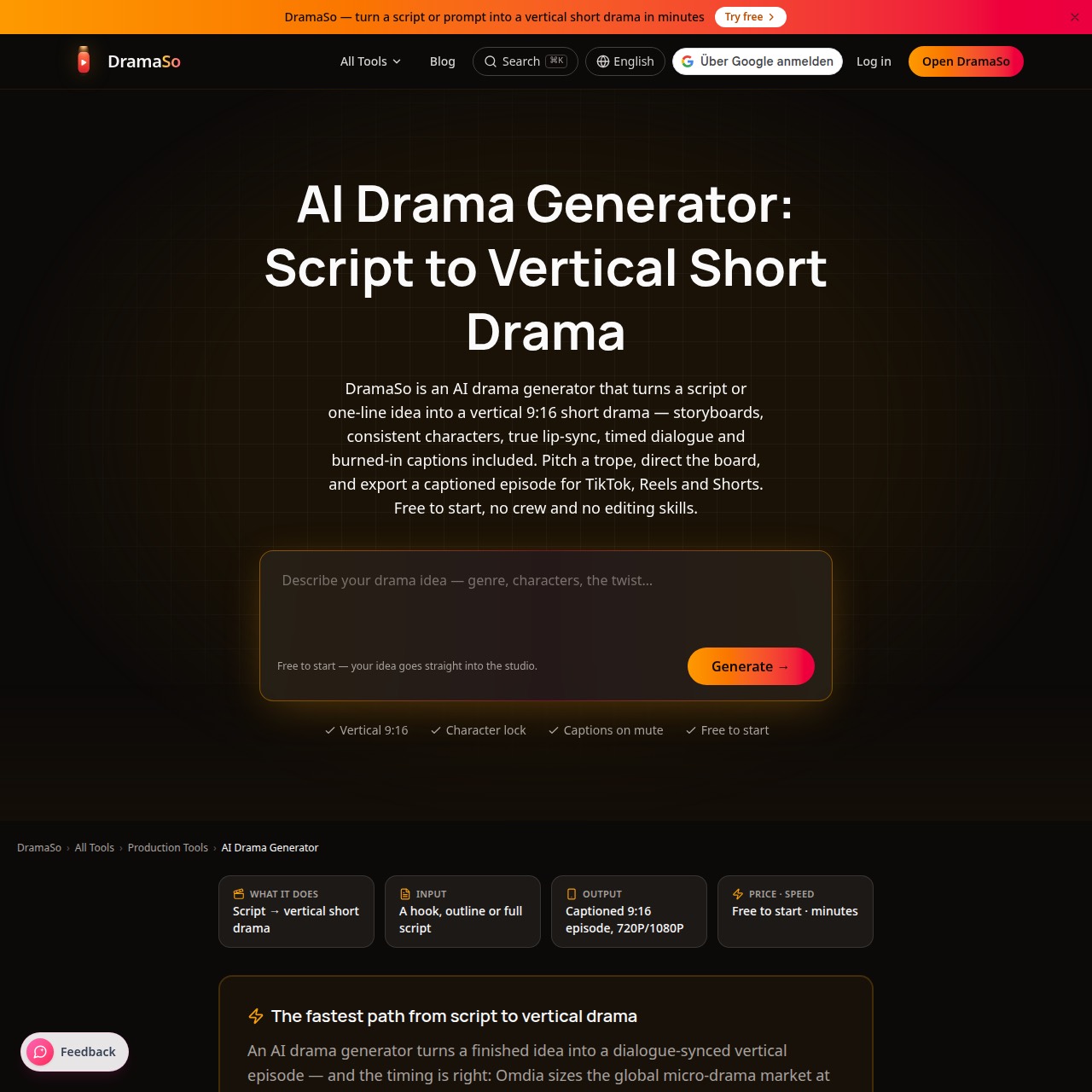
- Idea. Type the premise in one or two sentences: “A fired barista signs a one-year marriage contract with the new chairman, not knowing she saved his life as a child.” At creation you can set hook strength, where the twist lands, and the ending type (for example, a cliffhanger ending for every episode).
- Script confirmation. DramaSo writes the episode script and stops for you to approve it before any credits go to images or video. This is where you check the four beats against the table above. If the twist lands at 0:55 instead of 0:40, fix it here; it costs nothing.
- Characters locked. The CEO, the heroine and the antagonists are set once and their identity carries across episodes, so episode 30 has the same faces as episode 1.
- Storyboard. Each beat becomes shots. If a viral CEO drama already has a structure you like, paste its script and DramaSo breaks it into beat templates you can remix onto your own story, keeping the rhythm without copying the plot.
- Shots. Generate the shots, then regenerate only the ones that miss. Common fixes in this genre: the hand on the contract, the reaction face at the twist, the final frame of the cliffhanger. The 3D director desk helps when you need two characters blocked in a room for the boardroom scene.
- Export. Export the finished vertical episode, or FCPXML to finish the edit in Final Cut or Premiere. DramaSo doesn’t post to TikTok or YouTube for you; you upload it yourself.
What does an episode cost? A 60-second episode (10 shots × 6s, with storyboard images, video, dubbing and export) runs about 1,074 credits on the Fast tier, 3,254 on the default Standard tier and 9,284 on Cinematic. A reasonable plan for a new series: run the first three episodes on Fast to test the story, then move the episodes that perform to a higher tier. Current prices are on the pricing page, and the full budget math is in AI short drama production cost.
If you’d like a general walkthrough of making addictive TikTok-style short dramas before you start, this third-party tutorial covers the basics:
Mistakes that kill a CEO romance
- A CEO who is only cruel. “Domineering” works when he’s cold in public and protective in private. Give him one protective act per episode, even a small one.
- A heroine who only cries. She must win something in every episode: a sharp answer, a skill revealed, a person put in their place. Her small wins are the dopamine; his protection is the romance.
- Spending the big reveal early. If everyone learns she’s secretly connected to him in episode 8, you have nothing left to sell for episodes 9–60.
- Dialogue-only clues. Most viewers watch on mute at first. If the twist needs the line to land, add an image that lands it too.
- Episodes that run long. Two minutes of a car ride is a scene, not an episode. If a beat has no status change, cut it.
Practical rule: Every episode, she wins one small thing and he protects her once. If either is missing, rewrite before you render.
FAQ
What is a CEO romance short drama?
A vertical drama genre built on a power gap between a wealthy, cold male lead (often a CEO or billionaire) and a heroine with little status, usually forced together by a contract, accident or debt. In Chinese it’s called 霸总. It’s among the most common formats on drama apps; see what is AI short drama for the wider format.
How many episodes should a CEO romance have?
TheWrap’s industry explainer describes the standard paid series as 60 to 100 minutes of total runtime cut into roughly 90-second episodes. For a TikTok series, many creators start with a 10–20 episode arc and extend if it performs. DramaSo can plan a season of up to 60 episodes from one idea; the AI episode generator covers that.
Can I make a CEO romance AI drama for TikTok and earn from it?
You can post it like any other video. Earning through TikTok’s Creator Rewards depends on the account and on videos being at least one minute long. Details are in the TikTok Creator Rewards FAQ for AI short dramas.
Which AI tool is best for CEO romance dramas?
For a multi-episode series, pick a tool that keeps the same cast across episodes and lets you approve the script before rendering. Our best AI drama generator 2026 comparison covers eight tools and when to choose each.
Have a CEO romance premise in one sentence? Start it in DramaSo: approve the script first, lock the cast, then render episode 1. Welcome credits on sign-up, no card required.
Popular guides
More in this series
- How to Make a Revenge AI Short Drama (Episode Beats + Workflow)
- Consistent Characters in AI Short Drama: H3 Max Turbo Face Lock vs H3 Max, Seedance, Kling O3 and Wan 3.0
- Kling 4.0 for Short Drama, Tested: API Timings, Real Costs and 30-Second Shots
- How to Turn Text into an Animation You Can Play
- Gemini Omni 1.1 Flash for Short Drama: Keep the Lead Across the Cut
View all 23 articles in Making AI Short Dramas →