/logo.webp)
The 7 Best AI Drama Generators in 2026 (With Honest Limits)

An AI drama generator turns a one-line idea, a script or a novel into a vertical short drama — handling storyboards, voiceover, character consistency and the finished export, so creators with no film crew can make episodes. But before you pick one, see through the thing every list glosses over: these tools are not competing for the same job. Some are shot engines that spit out one gorgeous six-second clip (Dreamina, Hailuo). Some are marketing machines that grew a drama feature later (Topview, Pippit). Only a few are actual series workbenches built around an episode — even a whole season (DramaSo, and partly Novi AI). Pick the wrong category and no amount of prompt skill saves you.
This ranking covers 7 tools, all verified against the vendors’ live pages on July 24, 2026 (see the methodology at the end). Full disclosure: DramaSo is our own product, so I rank it #1 — but it earns that spot on one thing nobody else has (it is genuinely built for a whole season), not on being “best at everything.” Every claim links to a source page you can open yourself, our own limits sit next to rivals’ weak spots, and the picks section says outright “buy the competitor for this.” Where a number couldn’t be verified, it says “undisclosed” — no guessing.
Contents
- The 7 tools at a glance
- 1. DramaSo — built for a whole season
- 2. Topview — marketing video + full pipeline
- 3. MagicLight — one-shot render, longest runtime, multilingual
- 4. Pippit — template-heavy marketing dramas
- 5 & 6. Dreamina / Hailuo — one gorgeous shot
- 7. Novi AI — script-first + storyboard workflow
- So which one should you pick?
- How I checked this list
- FAQ
The 7 best AI drama generators at a glance
Verified 2026-07-24. Prices in this category move fast — open the linked page and confirm before you pay.
| Tool | Best for | Built on | Verified entry price | Free path |
|---|---|---|---|---|
| DramaSo | Series / a whole-season world | End-to-end pipeline + Kling-class lip-sync | Free to start; paid unlocks watermark-free 1080P | Welcome credits, no card |
| Topview | Marketing video + full pipeline | In-house writer + storyboard + video | ~$16/mo (annual $192) | No standalone free tier listed |
| MagicLight | One render, longest runtime | 19 models (Gemini Flash 3.5 / Veo 4) | Plan numbers unlisted | Free credits |
| Pippit | Template marketing dramas | Seedance 2.5 / Veo 3.1 / Sora 2 | Undisclosed | Free tier |
| Dreamina | Best single-shot quality | Seedance 2.0 / 2.5 | Undisclosed | Daily free credits |
| Hailuo | Fast single shots | MiniMax | Undisclosed | Free credits |
| Novi AI | Script-first + storyboard | Multi-model (Sora 2 / Veo 3.1 / Kling…) | Undisclosed (region-gated) | 80 free coins |

Practical rule: Before you open any pricing page, name your output unit — is it a shot, an ad, or season 2, episode 7? That one word kills two-thirds of the shortlist.
1. DramaSo — built for a whole season, not just one shot
Best for: creators making a series — same cast, coherent world, a cliffhanger every episode.
Most tools keep characters consistent only within one clip. What makes DramaSo different is that “season / episode / cliffhanger” are first-class citizens in its data model. You can plan a season arc of up to 60 episodes from a single idea, then render each episode in order — every new one inherits the previous cast, wardrobe, voices and look, and ends on a hook that bites into the next. This is exactly the trap you hit with a shot engine around episode 40: cross-episode consistency was never on its roadmap.
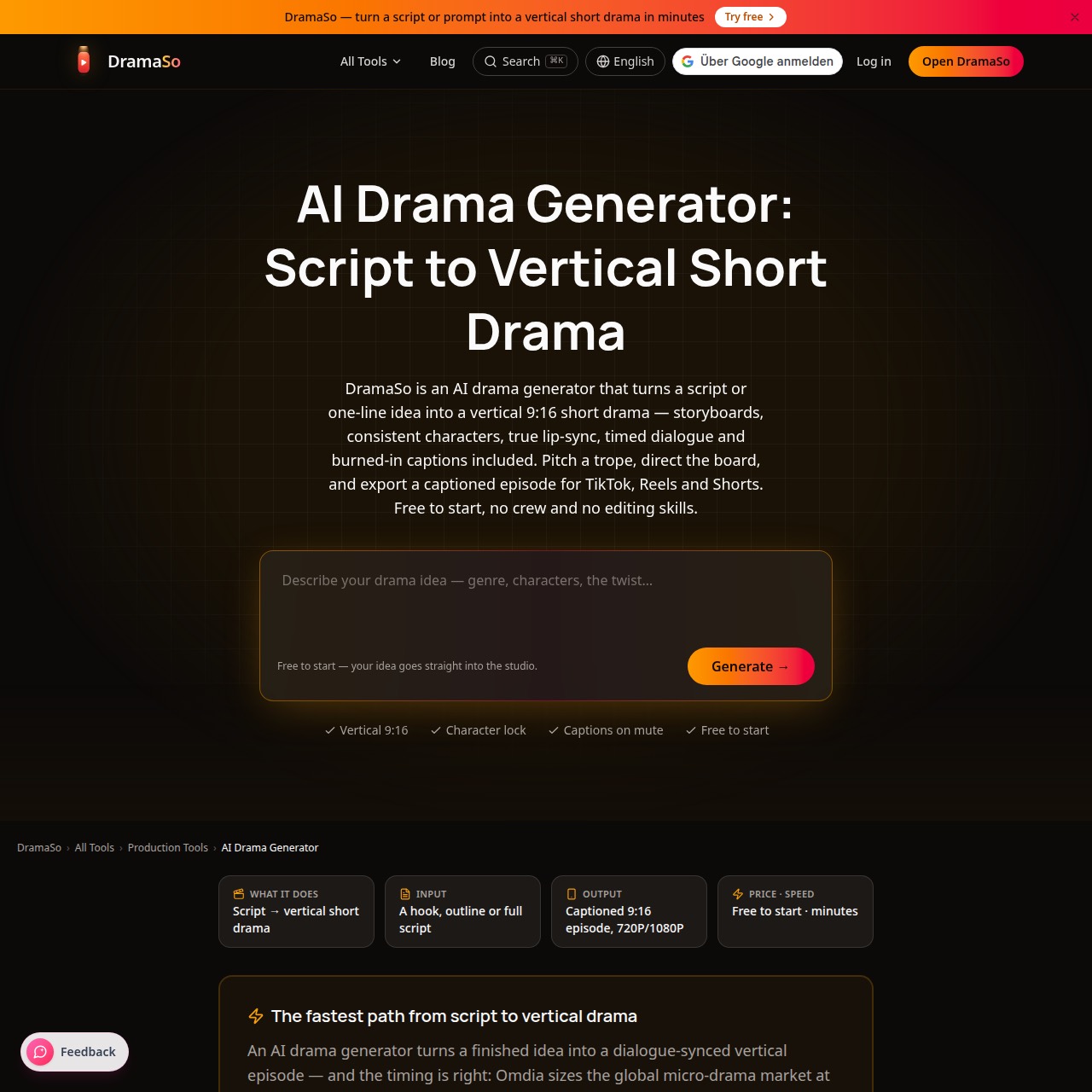
- Built on & workflow: an end-to-end pipeline — from a one-line idea through AI script → AI storyboard → AI scene → finished film, organized into a series by the AI episode generator. True lip-sync runs on Kling-class models, dialogue is timed line-by-line, captions burned into the 9:16 safe zone. Full capabilities on the AI short drama generator page.
- Pricing: free to start; paid plans unlock watermark-free 1080P export.
- Free path: welcome credits on sign-up, no card required — enough to run one full episode before you decide.
- Standout strengths: ① cast / wardrobe / look inherited across episodes ② native 9:16 with the hook placed where retention curves demand ③ cliffhanger chaining builds binge momentum into the season.
- Honest limitation: it is not a general ad / editing tool. For a 30-second brand ad or bulk e-commerce videos, Topview and Pippit have the deeper template libraries — don’t force DramaSo into that job.
Practical rule: If your output unit is “the next episode,” pick a tool that has season in its data model — not the one that tops a quality leaderboard.
2. Topview — best for marketing video + wanting the full pipeline
Best for: teams and solo creators making marketing dramas who want a ready-made one-stop flow.
Topview started as a marketing-video tool and later grew a full Drama Studio that chains AI writing, storyboard, character/scene, render and voiceover-captions into one line. It’s one of the few marketing-lineage tools that takes “drama” — not just “shot” — seriously.
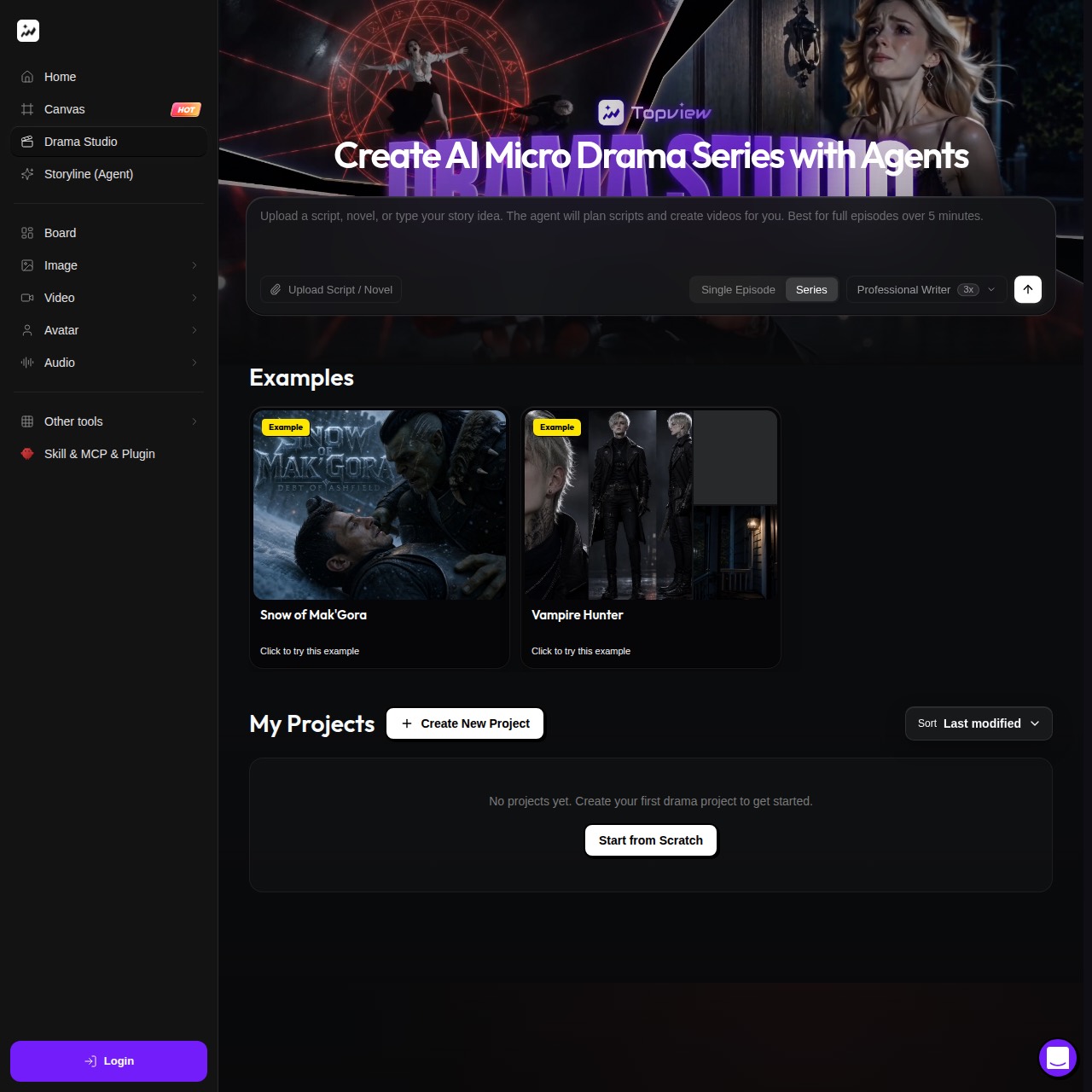
- Built on & workflow: in-house AI writer + storyboard + video generation; feed a concept / script / novel, get a vertical export tuned for TikTok / Reels / Shorts.
- Pricing: ~$16/mo (annual ~$192) — one of the few here that puts a real number on the table.
- Standout strengths: full pipeline packaged, natively vertical, low barrier to start.
- Honest limitation: the product’s center of gravity is marketing video; season-length planning isn’t its home turf — drama is a piece it filled in alongside its main job, not something designed for a series from scratch.
3. MagicLight — best for a one-shot render, longest runtime and multilingual
Best for: creators who don’t want to touch the controls and want the whole film made in one pass.
MagicLight is the most automated tool here. Its site lists 19 story models (including Gemini Flash 3.5 and Veo 4), 37 voice options, a single narrative up to ~50 minutes, and subtitle/narration export in 11 languages, plus 40 background tracks and 16 caption styles (source: MagicLight’s tool page, verified 2026-07-24).
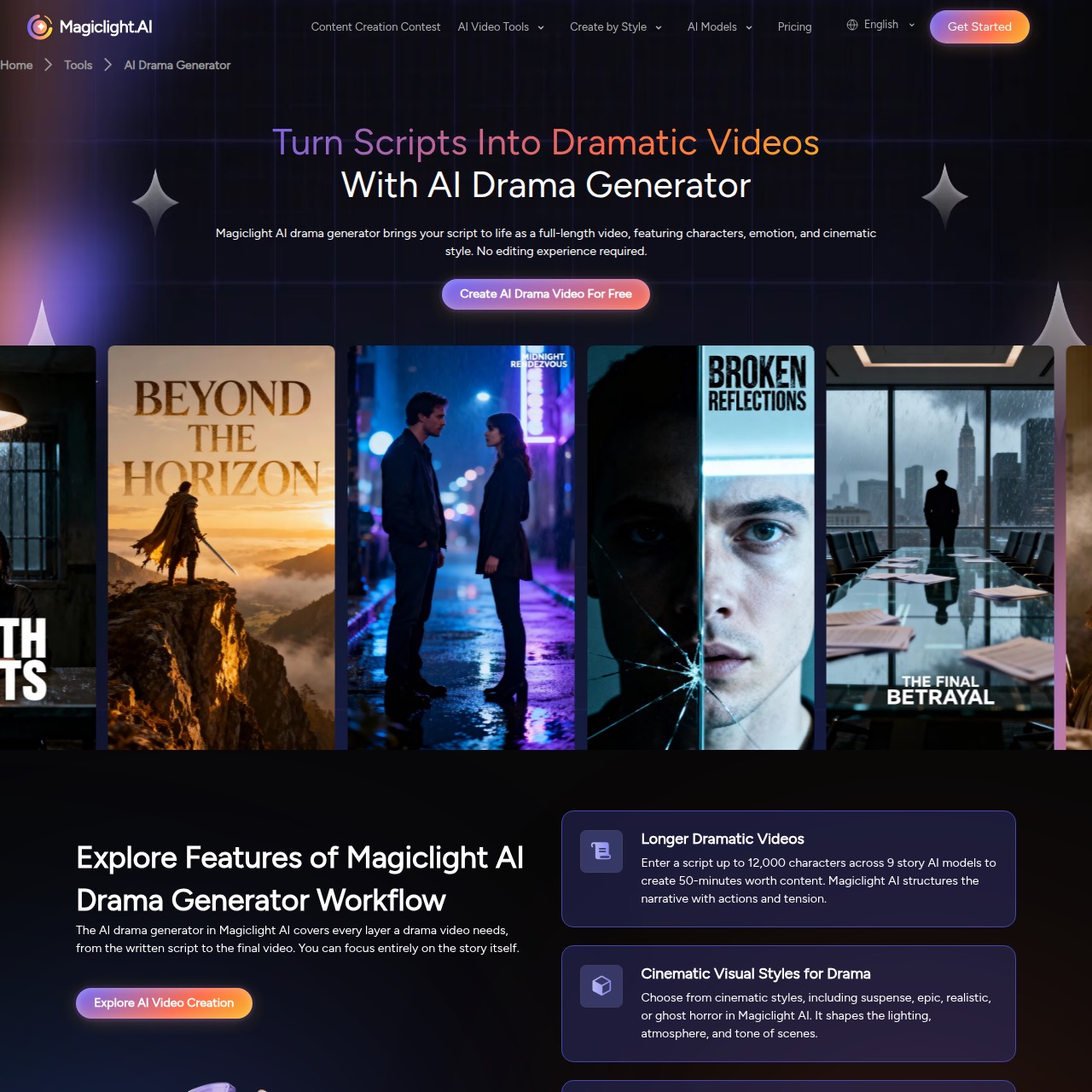
- Workflow: give it an idea and it generates structure, characters, voices and score in one pass; “Nano Storyboard” lets you nudge expressions and camera per shot.
- Pricing: the tool page doesn’t list plan numbers — check the pricing page for export limits before upgrading.
- Standout strengths: hands-off rendering; runtime and language coverage are among the strongest here.
- Honest limitation: heavy automation means weak manual control — it makes the calls for you rather than handing you a per-shot steering wheel.
Practical rule: Any comparison that hands every tool a neat 10-point score reads like an ad. A real review has holes, and it tells you where they are.
4. Pippit — best for template-heavy marketing dramas and commerce
Best for: creators doing e-commerce and marketing-lean dramas who want to ride the template library.
Pippit, backed by ByteDance, runs the template-factory playbook — tens of thousands of templates on trending terms — on top of Seedance 2.5 / Veo 3.1 / Sora 2 (Sora 2 handles 12-second seamless transitions).
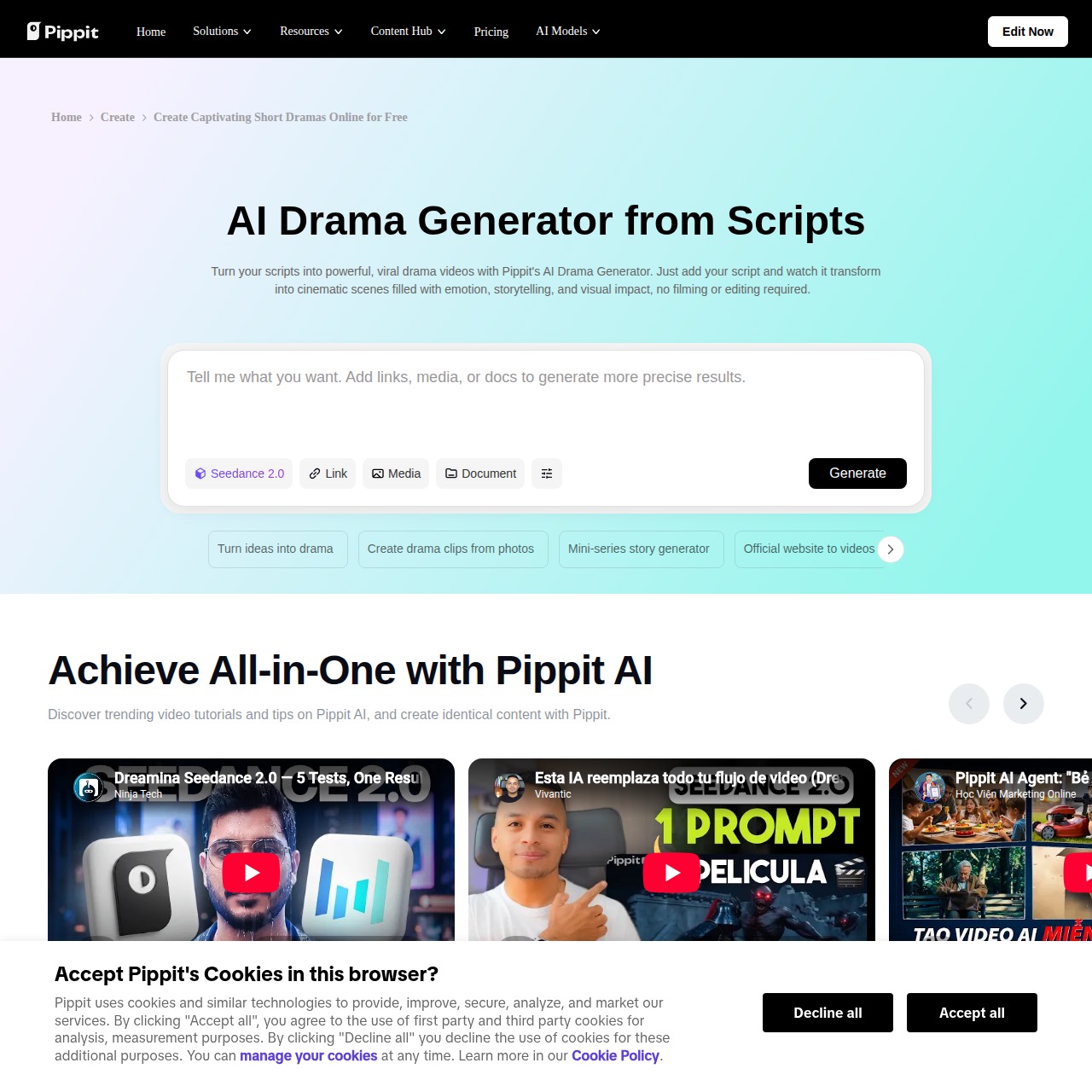
- Workflow: create an account → upload images / clips / a script → pick a model, set ratio, length and language → generate → refine by prompt + advanced editing → download or publish directly.
- Pricing: not shown on the tool page; visible after login.
- Standout strengths: huge template count, ByteDance resourcing, AI talking photos + auto captions + multi-platform publishing.
- Honest limitation: its center of gravity is marketing and commerce, not narrative series; pricing is opaque.
5 & 6. Dreamina / Hailuo — best for “one gorgeous shot,” not a whole episode
Best for: creators who need high-quality single-shot footage and will assemble it themselves.
Dreamina (Seedance 2.0 / 2.5) and Hailuo (MiniMax) are, at heart, shot engines: in seconds they hand you a gorgeous piece of motion, with in-clip character consistency and camera rhythm done well.
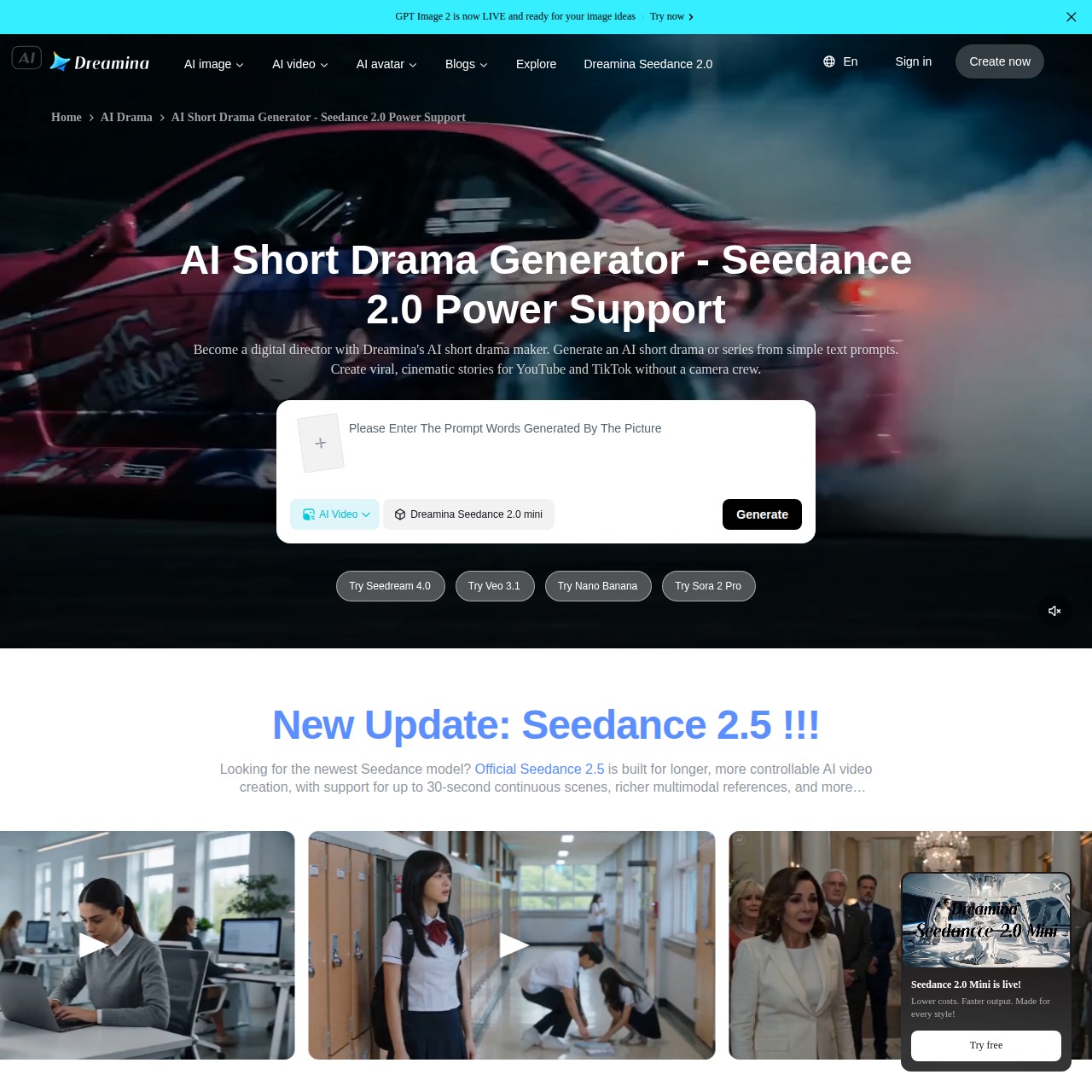
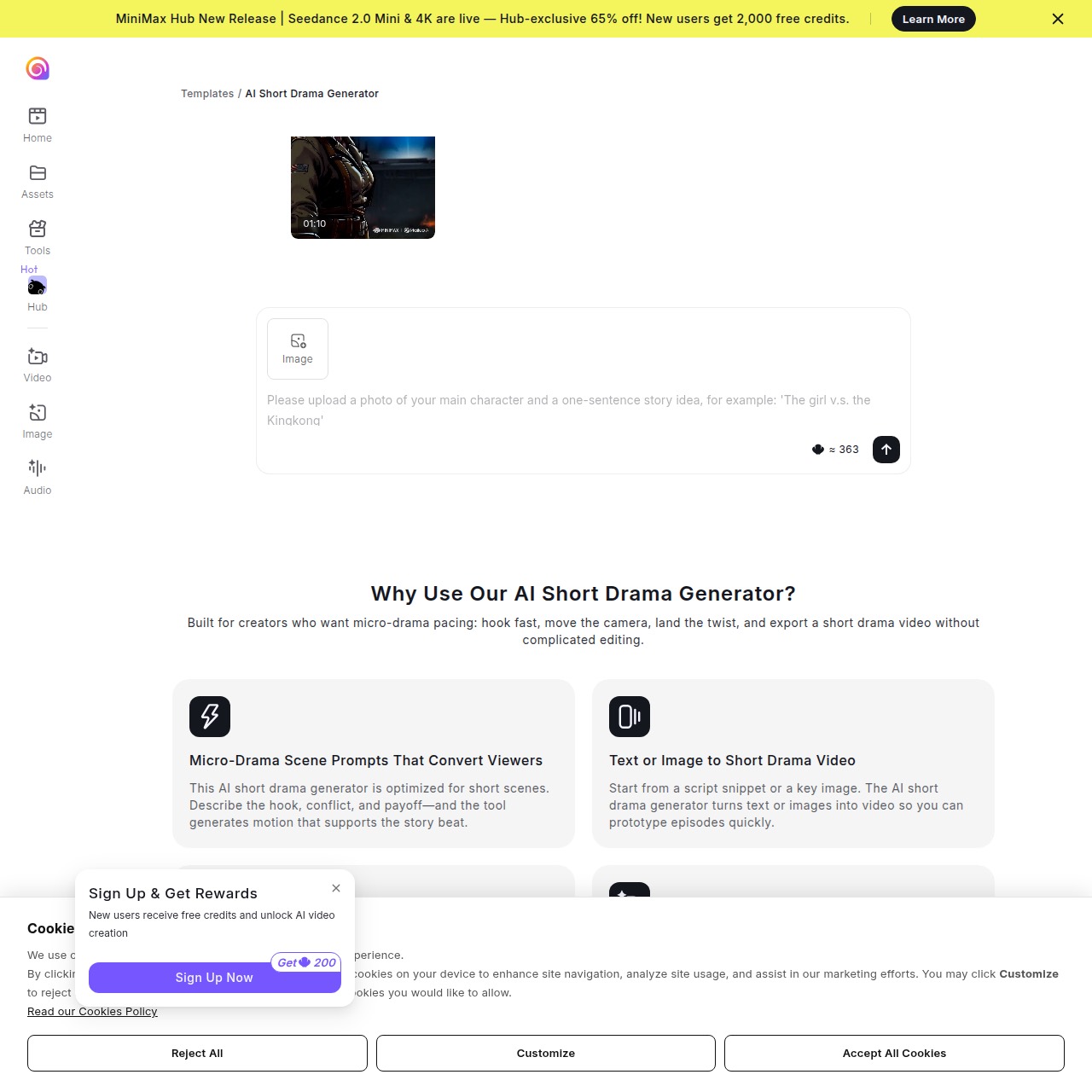
- Dreamina: ~30-second cap per clip (Seedance 2.5), Multiframes uses up to 10 images to hold a character, built-in precise lip-sync and auto soundtrack, daily free credits.
- Hailuo: turns one line into camera motion, rhythm is its strength; but short drama reads more like a feature it added on the side than a main focus.
- Shared honest limitation: a single generation is only seconds to tens of seconds long, so you stitch the episode together yourself — they don’t handle “episode” or “season.” Treat them as a footage source, then assemble in a series workbench.
7. Novi AI — best for script-first + a storyboard workflow
Best for: creators who like a structured “script first, storyboard second” rhythm.
Novi AI leads with script-to-drama, built on a multi-model stack (Seedance 2.0 / Sora 2 / Google Veo 3.1 / Runway Gen-4 / Kling V2.5 and more), offering both an automated Video Agent and a manual per-shot mode.
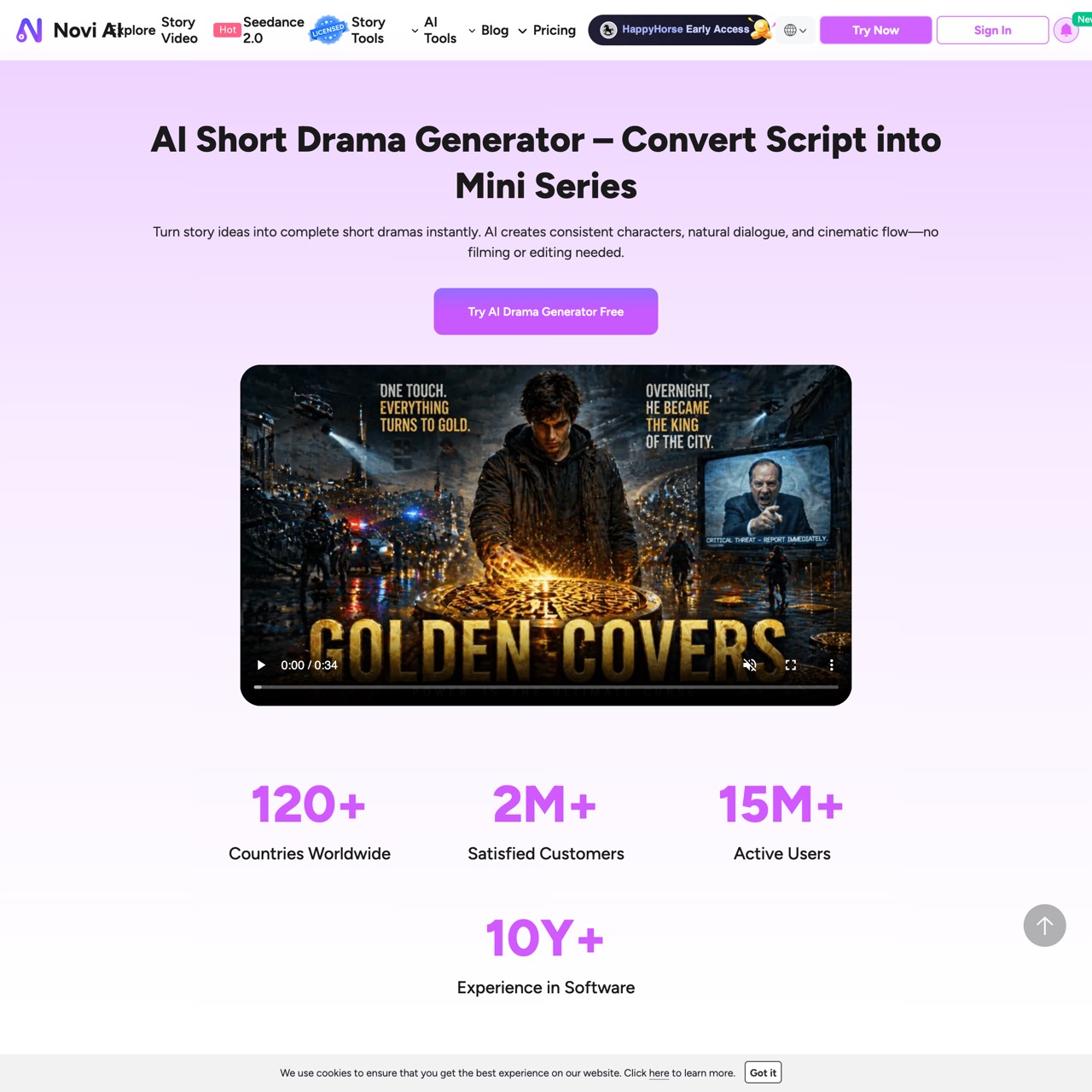
- Workflow: the Video Agent expands a concept into a full script with scenes and dialogue while keeping things consistent; or go manual for per-shot control.
- Pricing & free: 80 free coins on sign-up; the plan table was region-gated on my check date, so I couldn’t see the full pricing.
- Honest limitation: pricing is opaque, and the site lists an average generation time of ~116 minutes per drama — on the slow side. With any “no price until you log in” design, confirm the cost yourself before you commit.
So which one should you pick?
Work backwards from your output unit — it beats any total score:
- Output unit is an episode / a season (same cast, coherent world, cliffhangers) → DramaSo, and partly Novi AI.
- Output unit is a marketing ad / commerce video → Topview, Pippit — the fullest template libraries.
- Output unit is one good-looking shot → Dreamina, Hailuo — cheapest and fastest.
- You want one render, the longest runtime and multilingual → MagicLight.
The trap almost everyone falls into: buying a shot engine, then discovering at episode 40 that cross-episode consistency was never on its roadmap. The industry signal amplifies this — vertical micro-drama installs grew fast over the past year, and every vendor’s tool page now leads with it (verified 2026-07-24), which means the ability to make drama continuously only gets more valuable.
Practical rule: Don’t pick a series tool off a quality leaderboard, and don’t use a series tool for a single ad. Set the output unit first, then check whether the free credits cover one full episode.
How I checked this list
Every tool’s positioning, pricing and limitation was re-verified on the day of writing, with the check date noted; where something couldn’t be verified, it says so. I did not run one unified head-to-head across all 7 — that would burn months of credits, and pretending to have done it (then scoring each tool neatly) is the most common lie in this category. So this is a capability-and-economics comparison, not a quality leaderboard. Competitor screenshots are taken from each vendor’s own public page on the verify date; product shots use DramaSo’s own assets — every image traces back to its source.
Frequently asked questions
Is there a completely free AI drama generator?
Most tools offer free credits (DramaSo, MagicLight, Dreamina, Hailuo and Novi AI all do), but “free” usually means a watermark, a length cap or a usage limit. A watermark-free 1080P export almost always needs a paid plan — DramaSo is free to start and unlocks export when you need it.
Which has the best cross-episode character consistency?
If you need “cross-episode,” not “cross-clip,” pick a tool that has episode/season concepts in its data model; DramaSo is the most direct on that track. Pure shot engines (Dreamina, Hailuo) hold consistency well within a single clip but don’t handle cross-episode.
Can an AI drama generator replace live filming?
In the specific case of vertical short drama, increasingly close — it removes the crew, the location and the actor scheduling. But it’s better for fast output and iteration; high-budget prestige drama still has room for live filming.
How long does it take to generate one AI short drama?
It depends on the tool: shot engines (Dreamina, Hailuo) return a clip in seconds to tens of seconds, but you assemble the episode; one-shot tools take longer — Novi AI, for example, lists ~116 minutes on average per drama. Series workbenches render episode by episode, so the pace tracks how many episodes you plan.
How do I quickly pick the right one?
In one line: name your output unit — shot, ad or episode — match it against the table, then use each tool’s free credits to actually run one full episode before paying. Don’t judge on a single demo.
Want to turn a one-line idea into a whole season of vertical drama you can keep updating? Try DramaSo free — welcome credits on sign-up, no card required. Run one full episode on the free credits first, then decide whether to unlock watermark-free 1080P export. Name your output unit, run one full episode, and the answer surfaces on its own.
Popular guides
More in this series
- MagicLight AI Review: Good for Stories, Check the Consistency
- AI Short Drama Generators Compared: 6 Tools Side by Side
- Topview AI Review: An Honest, Source-Checked Look
- Runway vs Kling for Short Drama: Which AI Video Generator Wins? (2026)
- MiniMax Design (20 Aug 2026): a short-drama workbench, not another generate button
View all 8 articles in AI Drama Tool Comparisons →